

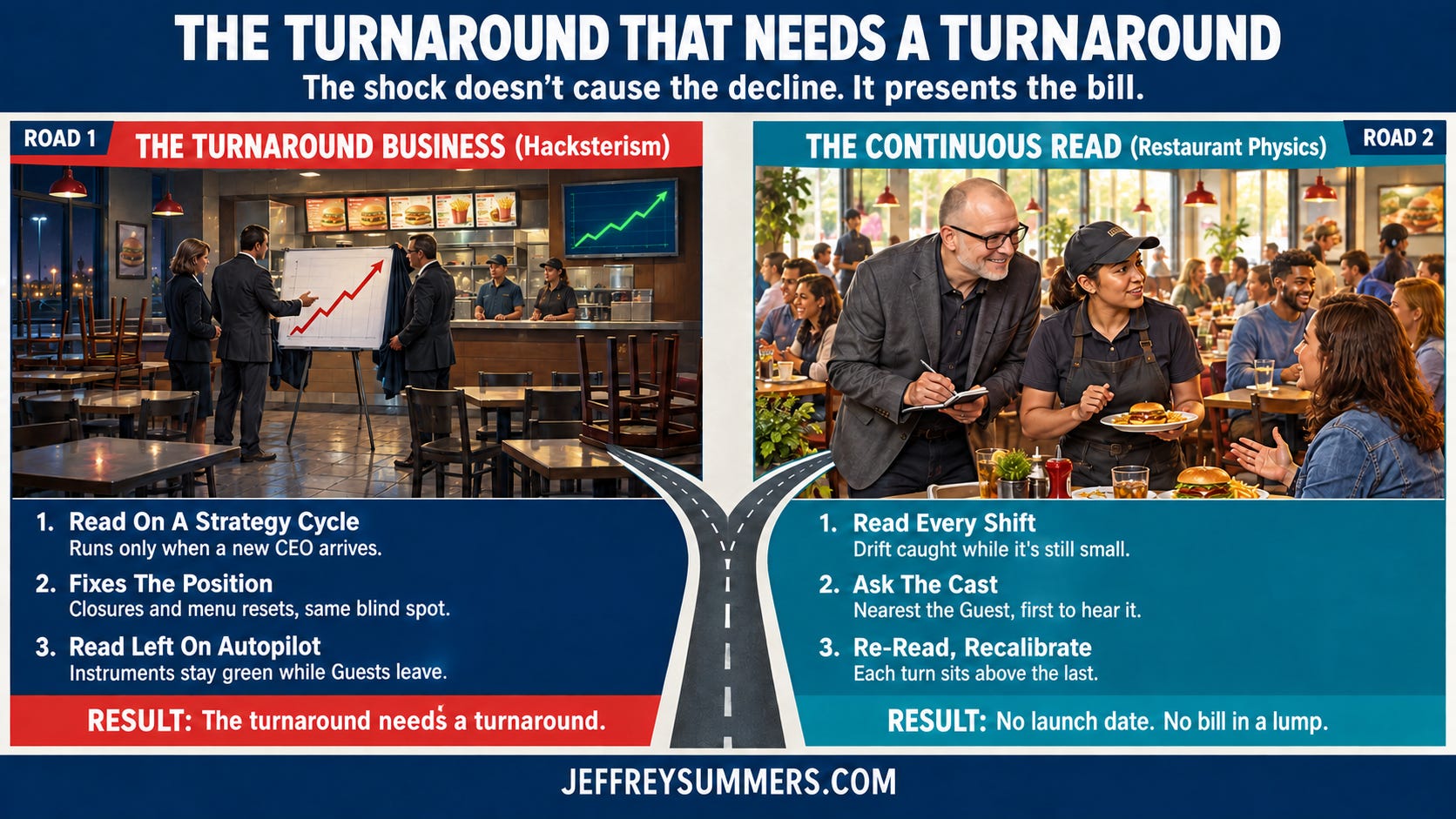
Wendy’s is the specimen. Since February 2024 it has had three chief executives and two turnaround plans. Project Fresh launched in October 2025 under an interim CEO, and when the board hired Bob Wright in May 2026 it said Project Fresh would “begin the turnaround.” Wright is now writing the next one, which he says is in its early stages. In the second quarter, U.S. same-store sales fell 7%, traffic fell 12.5%, Burger King passed Wendy’s in system sales, guidance was withdrawn and the dividend was cut. Wendy’s is not alone. In March, Restaurant Dive counted ten major chains overhauling themselves at once, and a new one seems to be announced after every fuel spike, cold January and soft quarter for the lower-income Guest. The mechanism is the same everywhere. Every relationship a restaurant runs drifts away from the terms it was built on, all the time. A chain that reads that drift on a strategy cycle instead of every shift lets it pile up unread. When the shock arrives it doesn’t cause the decline. It presents the bill. The turnaround pays the bill in one lump, resets the brand’s position, and leaves the read that ran up the bill exactly where it was. That is why the turnarounds now need turnarounds. The franchisee carries the building through all of it. The cast carries the Guest. The stakes are the brand’s cash, and also the franchisee’s restaurant and the jobs of the cast inside it.
Same Quarter, Same Guest, Three Results
Start with arithmetic, because it settles the alibi before anything else does.
In the second quarter of 2026, three burger chains sold to the same consumer, paying the same fuel prices, in the same economy. Burger King’s U.S. same-store sales rose 8.5%. McDonald’s rose 0.8%, with Guest counts down. Wendy’s fell 7.0%. In the same quarter Taco Bell rose 7%.
The weather tells the same story. Wingstop has explained its slide with lower-income consumers, fuel prices and weather. Chili’s went through the same January and reported that it was “recovering quickly after significant weather headwinds in January.”
If the shock caused the decline, it would have caused it everywhere it landed. It didn’t. The same conditions sent some chains up and some down. The shock sorted chains by what they had been doing before it arrived. What happened in the quarter decided only which ones it exposed.
One caution keeps the evidence honest. Burger King is not the counterexample to the turnaround business. It is in one, Reclaim the Flame, running since late 2022. Its parent company calls this quarter the “compounding return on four years of continuous improvements,” but that is the company describing itself, and it proves nothing about what Burger King reads. The spread proves something narrower, and narrower is enough: the conditions do not explain the result. The market shift was inside every chain’s read, or it should have been. The ones that could not see it coming had stopped reading before it arrived.
The Colonel, Twice
The strongest case that a turnaround is not a cure comes from the one that worked.
In 2015, after what Business Insider called decades of stagnant sales, KFC put Colonel Sanders back at the center of its brand. The Re-Colonelization worked. KFC posted thirteen consecutive quarters of growth.
Then it stopped working. Before Catherine Tan-Gillespie took over as president of KFC U.S. in April 2025, the chain had posted seven consecutive quarters of negative same-store sales. Domestic system sales fell 4.6% in 2025. The fix was called the Kentucky Fried Comeback. It publicly admitted the brand had lost its way, put Colonel Sanders back at the center of its marketing, and brought back Potato Wedges. A decade after the first comeback, KFC ran the same one again. And in 2026, after three winning quarters, the brand is in a global transformation, switching from Pepsi to Coke for what it calls a “more relevant experience for today’s customers.”
That is a turnaround of a turnaround, and it shows the failure mode the industry never names. The first comeback did install a read. For thirteen quarters the brand knew what its Guests came for, and the numbers said so. Then the read was left running on autopilot. The instruments stayed green, the reading stopped, and drift resumed where nobody was looking. You cannot install a read and let it run by itself. Doing that defeats the whole purpose of having a read. A read that gets installed and not maintained turns into a turnaround that needs a turnaround.
My framework names this. No Static Achievement: nothing accumulated in the operation can be held without continuing to earn it. Thirteen quarters of growth is an asset, and it was spent down the moment nobody kept earning it. Constant Expiry names why it gets spent. What the brand knew about its Guests in 2016 expired as fast as the Guests changed, and a read taken once, at the launch, is expired before the first quarter closes.
The Burrito Came Back
The Product case is Del Taco, and the Guests documented it themselves.
Jack in the Box bought Del Taco in 2022 for $575 million. Under Jack, the menu changed. In 2025, Jack sold Del Taco to Yadav Enterprises for $115 million, as part of Jack on Track, one of two turnaround plans Jack is running at once. The other is Jack’s Way. Restaurant Dive put Jack’s debt at $1.6 billion, 6.5 times EBITDA.
Two and a half months after the sale closed, Del Taco’s new owner launched its own turnaround, an 18-month plan called Project Sunrise. Its first move was to return the Classic Burrito line to its original preparation, its signature fold and its original names. The reason given was Guest complaints about menu changes made under Jack in the Box over the previous two years.
Read that sequence through Contract Drift: the gap between the terms a relationship was agreed on and the terms actually running in it. The Guest contract at Del Taco was, in part, a burrito. The running terms moved away from it. The Guests said so, for two years, inside the restaurants, to the cast. The gap was visible the whole time. Nobody owned it, and the correction waited for a sale.
Then look at what the correction is. Returning the burrito to its original preparation returns the operation to the state it was already in. In my framework that is Repair Work: solving a problem inside the frame it lives in, so the finished state is the prior state. It may be the right repair. It is still a repair. Nothing in it changes how the next drift will be read.
Wendy’s runs the same Product pattern at a larger scale. In the second quarter its average check rose 5.6% while traffic fell 12.5%, and the company cut back on discounting and breakfast hours. Wright now says Wendy’s will “rebuild the menu at the ingredient level, at the menu item level, and the category level, while also addressing the menu price architecture.” A menu that has to be rebuilt at every level drifted at every level, and nobody read it while it moved. That is Static Decline in public: a transactional means, discounting, run against a relational goal until the arithmetic came due. As I wrote in Dear Meritage, the demand decline arrived last. The architecture was finished before it got there.
The Read Runs On A Strategy Cycle
The Perspective failure is about timing, and every new chief executive confirms it on arrival.
Every turnaround begins with a read. When Todd Penegor, Wendy’s chief executive from 2016 to 2024, took over Papa Johns in August 2024, he started an aggressive 100-day plan, ran a franchise listening tour and concluded that the brand had shifted out of position on value for the money. When Wright arrived at Wendy’s, he identified five areas to fix. Both are reads. Both ran because a new chief executive arrived, which means the read on that scale runs when chief executives change.
That is what a strategy-cycle read looks like. The brand reads its market when the board hires, then executes the conclusion for years against a market that keeps moving. A competitor repositions on value, a cohort changes what it buys, a daypart thins. Each of those is the market contract drifting, and each is visible the week it starts. A continuous read catches it while it is small. A strategy-cycle read catches it when it is big enough to cost a chief executive his job.
The instrument the board reads makes it worse. Under Penegor, Wendy’s reached its twelfth consecutive year of same-restaurant sales growth, and in 2021 it passed Burger King to become the No. 2 burger chain. Same-restaurant sales is the instrument every board watches, and it can stay green while Guests leave, as long as the check rises faster than traffic falls. This year’s second quarter shows the gap in one line: check up 5.6%, traffic down 12.5%. My published work describes the operator who “stops doing the primary read because the secondary instruments are green.” At chain scale the dashboard is the board deck, and the primary read is the Guest.
Then the plans are written from the same pillars. Project Fresh had four: brand revitalization, system optimization, operational excellence and capital reallocation. Wright’s five are menu, branding and marketing, operations, digital, and restaurants. Strip the labels and the two plans cover the same ground, eight months apart. Restaurant Dive called Back to Starbucks “only the latest in a line of post-pandemic revival schemes.” That is the Sameness Machine at work in the boardroom: an approach built outside any specific brand, adopted without that brand’s own read having produced it, installed the same way everywhere. A plan that could have been written for any chain was not written from a read of this one.
Nobody Owns The Drift
The People failure is that drift gets seen by the people furthest from the decision, and they don’t own it.
At chain scale the franchisor owns the standard and the franchisee owns the building. The cast nearest the Guest hears the drift first. They heard the burrito complaints at Del Taco for two years. Nobody asks them, because the read runs in a strategy meeting, not on the stage. My Six-Actor Test names six actors every decision touches: the operator, the business, the Guest, the cast, the vendors and the community. A read that runs in the boardroom reads one of them, the business, and hears about the other five last.
Then the people who did install a read leave with it. When Penegor went to Papa Johns, he hired Kevin Vasconi, the Wendy’s chief information officer who led the company’s transformation and tripled its ecommerce business. Wright came back to Wendy’s from five years leading Potbelly. Mike Burns left Latitude Food Group in May to lead Cafe Rio through a brand turnaround. The turnaround has become a labor market with its own executive class, and the read travels with the executive. It leaves the building it was installed in.
Which means Full Consequence Read is skipped twice. It is the read an operator runs on a decision before he makes it: what the decision does to every actor it touches, in this period and in the periods after it, and what it forecloses for each of them. The decisions that let the drift run were not read that way. The menu change at Del Taco was not read against the Guest who complained about it for two years. Then the turnaround isn’t read that way either. When a chain closes 289 U.S. restaurants in a half, as Wendy’s did, the closures land on franchisees, cast and communities who had no part in the read that made them necessary.
Two Ways A Turnaround Fails
Performance is where the turnaround business shows its two failure modes, and most chains run both.
The first is that the turnaround fixes the position and leaves the read structure alone. It closes stores, repaints parking lot stripes, restores a burrito, reprices the menu. Jack’s chief financial officer said closures of underperforming Jack stores lifted sales at nearby locations by about 30%. That is real money, and it is moving Guests, not reading them. Starbucks closed 400 stores and cut 900 corporate roles. The closures are Repair Work at chain scale: the brand returns to a prior position, and the frame that produced the decline is preserved. The next shock finds the same blind spot.
The second is the one KFC demonstrated. The turnaround does install a read, and then nobody maintains it. The comeback becomes the strategy, the strategy becomes the deck, and the deck runs on autopilot while the instruments stay green. When the drift surfaces again, the brand calls it a new problem and buys a new turnaround.
My framework is built against both. Operating Helix is the loop the Five Fundamentals run inside: read, design, execute, re-read, recalibrate, then read again from a higher position than the last cycle left you in. Each turn is supposed to sit above the one before it. A turnaround is the opposite shape. It is a circle. The brand returns to where it was, as KFC did when it found the Colonel again, and calls the return progress. The corrective, as I wrote in Million Dollar Mediocrity, “is not a turnaround program.” It is the return to the primary read, run as a discipline and not as an event.
Every one of those bills was for a read nobody ran, so the answer isn’t a better turnaround, it’s a read with no launch date.
The Read With No Launch Date
Every restaurant runs on four contracts: with its Guests, its cast, its vendors and its market. All four drift, all the time, and no operator prevents that. What decides the outcome is whether someone reads the drift while it moves.
A read that happens is an event: a new owner, a new chief executive’s 100-day plan, a bad quarter that forces a look. A read that runs is a discipline, with a cadence, an owner and a place in the shift, the same as the line check. In my framework, Constant Expiry is why the event fails. What you know about your Guests starts expiring the moment you know it, so a read taken once is accurate for a shift and stale within a period. The discipline runs on Operating Helix: read, design, execute, re-read, recalibrate, then read again from a higher position than the last turn left you in. A turnaround is a circle that brings the brand back to where it was. The helix brings it back one level higher, every turn.
What It Looks Like On The Stage
Read the Guest before the report. Primary Read is the principle that the live read of the operation comes before the report, because the report is late by definition, and a sales line can stay green while Guests leave, as Wendy’s check did while its traffic fell.
Read the Guest contract against the plate. Every trimmed portion, simplified prep and pulled favorite moves the running terms away from the agreed terms. Catch it at the size of one plate and decide that week whether it stays or reverses, and you still have room to rebuild instead of repair.
Give every contract an owner and a cadence. The Guest contract gets read every shift on the stage, the cast contract every week, the vendor contract on every delivery and the market contract every period. Design the cast nearest the Guest into the read: one question in the pre-shift, the answer in the post-shift, the lead collecting it and the operator deciding what it means. Build it into the structure so it survives turnover, and run Full Consequence Read on any decision that changes a contract before it ships.
Keep the read running in the good periods. The danger is success: the covers are up, the pre-shift question gets skipped and the review becomes a look at the report. No Static Achievement is why that costs you. So schedule the re-read the same in a strong period as in a weak one, and every period compare what the read said against what the report showed.
A continuous read gets paid for shift by shift, in attention. A turnaround is the same bill, paid in a lump, with interest.
Read the prosecution: https://hacksterism.jeffreysummers.com/the-turnaround-that-needs-a-turnaround/
Read the architecture: https://physics.jeffreysummers.com/the-read-that-never-needs-a-launch-date/
Read the rework: https://jeffreysummers.com/why-i-dont-sell-restaurant-turnarounds/
One Move This Week
Install a post-shift re-read on one shift this week. Five minutes, run by the lead, before the cast leaves. Ask three questions, the same every shift: What did a Guest say about the food or the visit tonight? What came back, or didn’t get finished? Who didn’t we see that we usually see? Write the answers in one dated log, read it the next morning before you open the report, and run it again the next night.
— Jeffrey
Digging Deeper
Definitions in the Knowledge Base:
https://kb.jeffreysummers.com/
Terms used in this piece: Operating Helix, Contract Drift, Constant Expiry, Full Consequence Read, Six-Actor Test, Primary Read, Repair Work, Sameness Machine, Static Decline, No Static Achievement.
Restaurant Physics: https://physics.jeffreysummers.com/
Hacksterism: https://hacksterism.jeffreysummers.com/
Jeffrey Summers: https://jeffreysummers.com/
Sources Cited In This Piece
Restaurant Dive, March 26, 2026 — ten major chains in turnarounds (Chipotle Recipe for Growth, Jack on Track and Jack’s Way, Reclaim the Flame, Back to Starbucks, Project Fresh, Sweetgreen, Outback, Papa Johns, Noodles, Krispy Kreme); Jack’s two plans, $1.6 billion debt at 6.5-to-1 debt-to-EBITDA, closures lifting nearby sales about 30%, curb-appeal changes including repainted parking lot stripes; Back to Starbucks “only the latest in a line of post-pandemic revival schemes,” 400 store closures and 900 corporate roles cut — https://www.restaurantdive.com/news/major-restaurant-turnarounds-chipotle-outback-papa-johns/815249/
The Wendy’s Company, SEC exhibit 99.1, 2025 — Kirk Tanner departing, CFO Ken Cook named interim CEO — https://www.sec.gov/Archives/edgar/data/30697/000119312525156450/d22220dex991.htm
The Wendy’s Company, October 9, 2025 — Project Fresh launched; pillars brand revitalization, system optimization, operational excellence, capital reallocation — https://www.irwendys.com/news/news-details/2025/THE-WENDYS-COMPANY-LAUNCHES-PROJECT-FRESH-A-STRATEGIC-PLAN-TO-DRIVE-GROWTH-AND-ENHANCE-VALUE-CREATION/default.aspx
The Wendy’s Company, 2026 — Robert D. (Bob) Wright appointed President and CEO effective May 21, 2026; Project Fresh to “begin the turnaround” — https://www.irwendys.com/news/news-details/2026/Wendys-Appoints-Robert-D--Bob-Wright-as-President-and-Chief-Executive-Officer/default.aspx
Restaurant Dive, August 7, 2026 — Wright’s five areas (menu, branding and marketing, operations, digital, restaurants); “rebuild the menu at the ingredient level, at the menu item level, and the category level, while also addressing the menu price architecture”; turnaround strategy in its early stages; Wright led Potbelly for five years — https://www.restaurantdive.com/news/wendys-ceo-robert-wright-lays-foundation-turnaround-plan/827323/
Yahoo Finance, Wendy’s Q2 2026 earnings call highlights — U.S. same-store sales −7%, traffic −12.5%, check +5.6%; 289 U.S. closures in the first half; reduced discounting and breakfast hours — https://finance.yahoo.com/markets/stocks/articles/wendys-q2-earnings-call-highlights-200416138.html
TheStreet, 2026 — Wendy’s guidance withdrawn and further closures — https://www.thestreet.com/restaurants/wendys-more-restaurant-closures-turnaround
RHF News, 2026 — Wendy’s cuts dividend, pulls 2026 guidance — https://www.rhfnews.com/article/wendy-s-cuts-dividend-pulls-2026-guidance-in-turnaround-bid
Nation’s Restaurant News, August 7, 2026 — Wendy’s Q2 system sales $2.9 billion, Burger King $3.2 billion — https://www.nrn.com/top-500-restaurants/wendy-s-takes-steps-to-fix-its-brand-as-sales-fall-again
Nation’s Restaurant News, August 6, 2026 — Burger King U.S. same-store sales +8.5% in Q2 — https://www.nrn.com/restaurant-finance/burger-king-s-sales-took-off-last-quarter-but-popeyes-is-in-a-slump
McDonald’s, Q2 2026 results — U.S. comparable sales +0.8%, Guest counts down — https://corporate.mcdonalds.com/corpmcd/our-stories/article/Q2-2026-results.html
Restaurant Dive, same-store sales tracker — Taco Bell +7% in Q2 — https://www.restaurantdive.com/news/tracking-same-store-sales-24-major-restaurant-chains/742371/
CNBC, October 2, 2026 — Burger King Reclaim the Flame since late 2022 — https://www.cnbc.com/2026/10/02/burger-king-refranchising-turnaround.html
Morningstar / Dow Jones, August 6, 2026 — Restaurant Brands: “compounding return on four years of continuous improvements” — https://www.morningstar.com/news/dow-jones/2026080611071/burger-kings-turnaround-gains-steam-driving-restaurant-brands-quarterly-profit-higher-update
Yahoo Finance, Wingstop Q2 2026 earnings call — lower-income consumers, fuel, weather — https://finance.yahoo.com/markets/stocks/articles/wingstop-inc-q2-2026-earnings-212038024.html
Seeking Alpha, Wingstop Q1 2026 call — https://seekingalpha.com/news/4581971-wingstop-anticipates-2026-global-unit-growth-of-15-percent-to-16-percent-while-guiding-for
Brinker International, SEC exhibit 99.1, fiscal Q3 2026 — Chili’s “recovering quickly after significant weather headwinds in January” — https://www.sec.gov/Archives/edgar/data/703351/000070335126000013/fy26q3ex991-earningsrelease.htm
Business Insider, 2016 — KFC’s Colonel Sanders strategy after decades of stagnant sales — https://www.businessinsider.com/kfcs-colonel-sanders-boosts-sales-2016-10 and https://www.businessinsider.com/kfc-is-fixing-a-mistake-with-retraining-2016-4
Modern Restaurant Management — Re-Colonelization, thirteen consecutive quarters of growth — https://modernrestaurantmanagement.com/the-recolonelization-of-kfc/
Entrepreneur, June 10, 2026 — seven consecutive negative quarters before Tan-Gillespie took over in April 2025; domestic system sales −4.6% in 2025; Kentucky Fried Comeback; Colonel back at the center of marketing; Potato Wedges returned; three consecutive positive quarters — https://www.entrepreneur.com/buying-a-franchise/kfc-went-from-seven-straight-losing-quarters-to-three-straight-winning-ones
Restaurant Dive, 2026 — KFC global brand transformation — https://www.restaurantdive.com/news/kfc-names-first-global-chief-brand-officer-amid-identity-overhaul/829685/
CNBC, October 15, 2026 — KFC switching from Pepsi to Coca-Cola; “more relevant experience for today’s customers” — https://www.cnbc.com/2026/10/15/kfc-coca-cola-pepsi-switch.html and https://www.restaurantdive.com/news/kfc-ditches-pepsi-for-coke-2027-menu-remake/833219/
Jack in the Box, SEC exhibit 99.1, October 16, 2025 — Del Taco sold to Yadav Enterprises for $115 million — https://www.sec.gov/Archives/edgar/data/807882/000080788225000053/ex991-pressreleasexdeltaco.htm
Franchise Times, 2025 — Jack bought Del Taco in 2022 for $575 million; sold at a $460 million loss — https://www.franchisetimes.com/franchise_mergers_and_acquisitions/del-taco-was-supposed-to-be-a-very-good-deal-for-jack-in-the-box/article_16df79cc-ae3c-4843-a261-eebc919225db.html
Business Wire, March 4, 2026 — Del Taco launches Project Sunrise, 18-month roadmap; Classic Burrito line returned to original preparation, open-end fold and original names — https://www.businesswire.com/news/home/20260304534712/en/Del-Taco-Launches-Project-Sunrise-a-Transformative-Roadmap-to-Reignite-Brand-Growth
Orange County Business Journal, 2026 — Project Sunrise addresses Guest complaints about menu changes made under Jack in the Box over the past two years — https://www.ocbj.com/food/del-tacos-new-owner-introduces-improvement-plan/
Loyalty360, 2026 — Project Sunrise introduced two and a half months after the sale — https://loyalty360.org/content-gallery/daily-news/loyalty360-reads-target-investing-$1b-to-enhance-customer-experience-rewards-program-casey-s-lau
Papa Johns, August 1, 2024 — Todd Penegor appointed CEO; Wendy’s CEO 2016 to 2024; twelfth consecutive year of same-restaurant sales growth — https://ir.papajohns.com/news-events/news-releases/detail/7/papa-johns-appoints-restaurant-industry-veteran-todd-penegor-as-president-and-chief-executive-officer
Nation’s Restaurant News, 2024 — Wendy’s passed Burger King for No. 2 in 2021 under Penegor — https://www.nrn.com/quick-service/why-todd-penegor-came-out-of-retirement-to-lead-papa-johns
PMQ Pizza Magazine, 2025 — Penegor’s 100-day plan, franchise listening tour, Papa Johns “shifted out of position on value for the money” — https://www.pmq.com/papa-johns-seeking-balance-on-the-comeback-trail/
Nation’s Restaurant News, 2024 — Papa Johns hires Kevin Vasconi, former Wendy’s CIO who led the company’s transformation and tripled its ecommerce business — https://www.nrn.com/quick-service/papa-johns-hires-former-wendy-s-executive-kevin-vasconi-as-chief-digital-and-technology-officer
Restaurant Dive, July 13, 2026 — Mike Burns left Latitude in May to lead Cafe Rio through a brand turnaround — https://www.restaurantdive.com/news/latitude-food-group-new-ceo-james-o-reilly/825046/
Restaurant Dive, 2024 — Penegor left Wendy’s, replaced by Tanner effective February 5, 2024 — https://www.restaurantdive.com/news/10-restaurant-ceo-changes-from-2024/734782/