

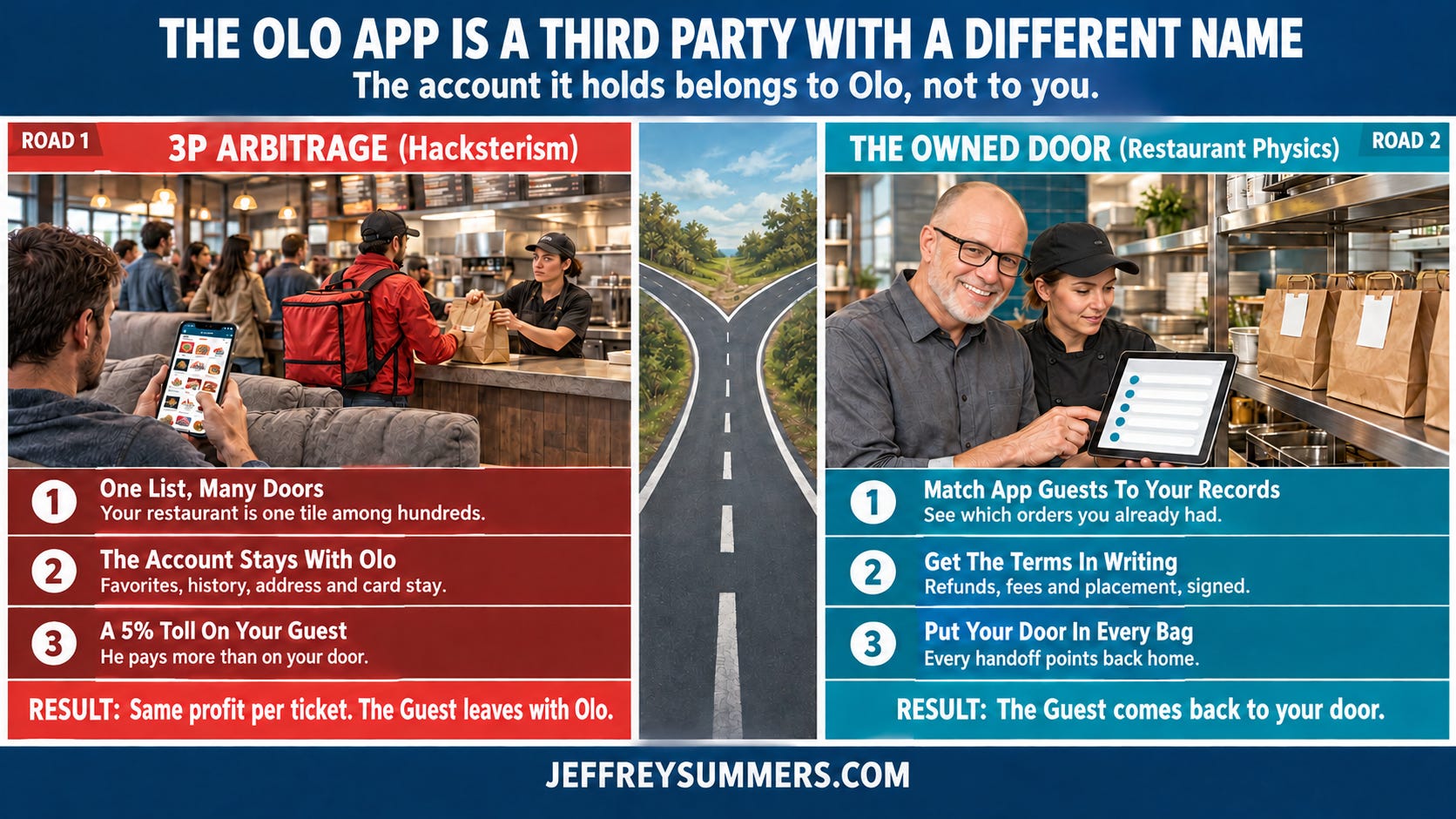
The Olo App is a third-party marketplace under a different name, because what makes a third party is holding the Guest’s account between the restaurant and the Guest, and that is the one thing Olo kept.
Olo is the company operators pay to build their own ordering. In October 2026 it opened a door of its own, the Olo App, and stocked it with the brands that pay it. The Guest signs into an Olo Account, picks a restaurant off a list of hundreds, and pays Olo a 5% network fee on the order. The restaurant pays no commission. Noah Glass, Olo’s founder and CEO, calls it second-party ordering, a new category between the restaurant’s own ordering and DoorDash and Uber Eats. It runs on every operator who built his direct door on Olo’s stack. What it costs him isn’t on the ticket. It’s the next order, because the account the Guest opens to place it, with his favorite brands, his order history, his address and his card, belongs to Olo. What’s at stake is the Guest the operator already had.
The Olo App Calls Itself Second Party. The Account Says Third.
Glass says it plainly. When Olo announced the app in March, he wrote that Olo “coined a new term: ‘Second Party Ordering.’” Olo’s own announcement describes “a second-party ordering platform where restaurants share network-level data while each brand maintains full ownership of the guest relationship.” In October he wrote that “the brand keeps the guest relationship and the data,” and in the same post that “40 million guests already have an Olo Account,” where “your favorite brands, order history, delivery addresses, and payment details come with you.”
Both can’t be true in the same app. The order data goes to the brand. The relationship goes with the account, and the account goes with the Guest to the next brand on the list. A second party would be inside the relationship. Olo sits between the restaurant and the Guest, holds the account and gets paid on the order. That is 3P Arbitrage: the vendor builds the vehicle the operator didn’t build and inserts itself between the operator and the Guest. Guests don’t prefer the vendor. They prefer the vehicle. “Second party” is the label that tells the operator this time is different. Judge it by what the app does, not by what it’s called.
Olo App, DoorDash And Uber Eats Are Three Doors To The Same List
Read it from the Guest’s side. He opens one app, signs into one account and scrolls one list. The restaurant is a tile. Glass says who it’s for: “We built this for the big middle: guests who love variety.” A Guest who loves variety is choosing the list, not the restaurant. That is Customer Architecture. The list produces Customers for whoever owns the list.
The three doors differ in one place, who pays the rent. DoorDash charges the restaurant 15%, 25% or 30% on delivery, and DashPass, the $9.99 a month membership, only comes with the 25% and 30% plans. Uber Eats charges 20%, 25% or 30%, and on its 25% plan an Uber One member’s order costs the restaurant 30%. The member thinks he paid for his free delivery. The restaurant’s higher rate pays for it. The Olo App charges the restaurant nothing and the Guest 5%. Same list, same courier pool, same tile. Only the rent payer changes.
The arrangement isn’t new either. DoorDash sells commission-free online ordering for the restaurant’s own website and runs the marketplace next to it. Olo came at the same arrangement from the other side. It built operators their own doors first and opened the list second.
Same Pipe Is Not The Same Door
Glass told Restaurant Dive that an app order “looks exactly to the restaurant as if it came through that first-party ordering platform.” He offers that as the benefit. It is the problem. If the app order looks direct, the operator’s reports can’t tell him which Guest placed it. One Guest would have ordered on DoorDash, and Olo saved the operator a commission. The other would have ordered on the operator’s own door, and Olo now sits in the middle of an order he already had.
When I put this to Glass, he answered: “If they DO order through the Olo App, the restaurant gets the same guest data and same profit as a direct order.” Same profit as a direct order means the app is no cheaper than the door the operator already built. It is only cheaper than DoorDash and Uber Eats. Olo sells the first Guest and doesn’t separate him from the second.
The operators at BWG Global’s October 21 delivery forum called the app a “credible 1P alternative,” and said DashPass and Uber One membership “limits the addressable switching pool.” The member who prepaid for delivery stays where his membership is. The Guest with no membership holding him to a marketplace includes the one already ordering on the operator’s own door.
The Courier Is Still At Your Counter
App delivery orders go through Olo Dispatch, which, in Glass’s words, “will ping all the different delivery services that serve that restaurant.” Restaurant Dive reports those drivers are often DoorDash and Uber Eats couriers. Olo’s own Dispatch documentation has the restaurant paying the delivery service, less the delivery fee it passes on to the Guest, and it can carry a per-order transaction fee on top.
So the cast hands the same bag to the same courier in the middle of the same shift. When the order is late or wrong, the Guest blames the restaurant, not the courier, and not Olo. Olo hasn’t said publicly who pays the remake or the refund on a bad app order. Whoever pays it on paper, the cast pays it in the shift, and the Guest standing at the counter waits while they do. “Same profit” counts the ticket. It doesn’t count the shift.
Not Now, Not Ever Covers The Restaurant, Not The Guest
In August, Glass made two promises: “Zero commission. Not now. Not ever.” and “Your guest data is yours.” The first covers what the restaurant pays. The 5% sits on the Guest, and no promise covers it. In October he added: “Circle back with us in 2030.”
The marketplaces already show where a list goes once it holds the Guests. DoorDash’s top plan includes sponsored listings. Uber Eats sells visibility through ads and offers. Olo hasn’t said publicly whether placement on its list will ever be sold, or whether the 5% and the zero commission are written into the operator’s contract or only into a post.
Same Profit Per Ticket Is Not Same Profit Per Guest
Of a 15 to 30% commission, Glass told an interviewer: “That I would argue is all of the profit of the transaction.” It isn’t. The profit in a restaurant isn’t one ticket. It’s the Guest who comes back to the restaurant’s door. Against DoorDash and Uber Eats, the Olo App wins the ticket: no commission and no menu markup. Against the operator’s own door, it ties the ticket and loses the relationship. The Guest pays 5% more than he would have on the restaurant’s door, learns to open Olo’s app instead, and the account stays with Olo. The vendor that supports the operator’s direct ordering now runs a door that competes with it. A cheaper toll is still a toll.
The only door that charges no toll is the one the operator already owns.
Your Door Is The Only One That Keeps The Guest
Your own ordering door keeps the Guest only when it’s the better way to order from you, because the Guest doesn’t prefer DoorDash, Uber Eats or the Olo App, he prefers the vehicle, and the operator who builds the better vehicle keeps him. That’s Gap Arbitrage: the operator who scans for the vehicle his Guest needs and builds it keeps the vehicle, and the operator who doesn’t hands it to a third party by default. The gap isn’t the ordering software. Most operators already have it. The gap is the reason the Guest comes back to it.
Olo’s own survey says where that reason is built. Olo and Restaurant Dive’s Studio surveyed 150 restaurant leaders and published the results in October 2026. Nearly two-thirds of brands keep fewer than one in five first-time Guests past 90 days. The brands that keep them are 44 percentage points more likely to have optimized kitchen capacity and load balancing, 48 points more likely to have improved digital ordering and checkout, and 48 points more likely to offer better handoff and pickup. Two of those three are inside the restaurant. The third is the operator’s own checkout. None of them is on a list.
Read every order by the Guest who placed it, because the app won’t. Every app Guest the operator can match to his own door’s records from before the launch is a Guest he already had. Every one he can’t is new. That read decides whether the app is adding Guests or moving the ones he has.
Then build the door around how the Guest lives. Price it at the room, so the only price difference the Guest ever sees is the toll the other doors add. Make pickup the direct offer. On the operator’s door it carries no delivery charge and no 5%, so it’s the cheapest way to get his food anywhere, and the Guest should know it before he orders, not after. Put the door on the bag, the one thing every off-premise Guest holds no matter which door he came through. And recognize the Guest who came back. Brands that run three or more of the survey’s five loyalty and win-back actions are nearly three times as likely to keep at least one in five first-time Guests, and each of those only works on a Guest the operator can identify. On his own door, he can.
Off-premise GX/CX is delivered at the handoff. The Guest never sees the kitchen. He sees the counter, the shelf, the bag and the person who hands it to him. The person who knows that standard closest is the one standing there at seven on a Friday. Design the handoff with her, not for her. Ask her where the orders stack up, what the Guest asks most at the counter, and what happens when an order goes out wrong. The answers are the design.
Then measure the second order, not the first. Olo’s own question is the right one: “What share of first-time guests order again within 90, 180, and 360 days?” Run it on your own door, by Guest, every period.
Against DoorDash and Uber Eats, the Olo App saves the restaurant the commission. Against the operator’s own door, it ties the ticket, charges the Guest 5% more, and keeps the account that places the next order. Neither changes the economics. The fourth door does. No commission, no toll, and the next order stays with the restaurant that earned it. The Guest picks the vehicle. The operator who builds the better one keeps him.
Read the prosecution: https://hacksterism.jeffreysummers.com/the-olo-app-is-a-third-party-with-a-different-name/
Read the architecture: https://physics.jeffreysummers.com/your-door-is-the-only-one-that-keeps-the-guest-the-olo-app-doordash-and-uber-eats-want-him-on-theirs/
Read the rework: https://jeffreysummers.com/i-sent-my-clients-to-olo-to-build-their-own-door-now-olo-runs-a-door-that-competes-with-it/
One Move This Week
Pull every Guest who placed a first order on your own door three periods ago, and count how many have ordered again. Then take that number to the person who runs your handoff during the rush and walk the last ten feet with her: where the bag waits, who hands it over, and what it says about whose food it is. That number is what your door is built to move. Read it again next period.
Jeffrey
Digging Deeper
Terms used in this piece: 3P Arbitrage, Customer Architecture, Gap Arbitrage. Definitions in the Knowledge Base:
https://kb.jeffreysummers.com/
Restaurant Physics: https://physics.jeffreysummers.com/
Hacksterism: https://hacksterism.jeffreysummers.com/
jeffreysummers.com: https://jeffreysummers.com/
Sources Cited
Noah Glass, LinkedIn, March 2026: “coined a new term: ‘Second Party Ordering’” https://www.linkedin.com/posts/nhglass_if-you-build-it-they-will-come-i-quoted-activity-7437829751899193344-70CZ
Olo, LinkedIn, March 2026: “share network-level data while each brand maintains full ownership of the guest relationship” https://www.linkedin.com/posts/olo_icymi-we-announced-the-olo-app-a-second-party-activity-7437880346337230848-s9dC
Noah Glass, LinkedIn, August 2026: zero commission “Not now. Not ever.”, “Your guest data is yours” https://www.linkedin.com/posts/nhglass_were-always-on-the-restaurants-side-for-activity-7467908003560824833-TxyR
Noah Glass, LinkedIn, October 2026: 40 million Olo Accounts, “the big middle,” “Circle back with us in 2030” https://www.linkedin.com/feed/update/urn:li:activity:7519005068302573568/
Noah Glass, LinkedIn reply to Jeffrey Summers on Ben Coley’s post, October 19, 2026: “same guest data and same profit as a direct order” https://www.linkedin.com/feed/update/urn:li:activity:7518008659159838720/
Restaurant Dive, October 21, 2026: 5% network fee, Dispatch, couriers often DoorDash and Uber Eats drivers, “second-party,” app orders look like first-party orders https://www.restaurantdive.com/news/olo-app-delivery-commission-fees-aggregator-competition/833536/
Rick Vanzura, “The Founder’s Journey: A Conversation with Noah Glass,” LinkedIn, April 2026: 15 to 30% commission “all of the profit of the transaction” https://www.linkedin.com/pulse/founders-journey-conversation-noah-glass-rick-vanzura-zo7ne
Olo and Restaurant Dive’s Studio by Informa TechTarget, Restaurant Growth By The Numbers, October 2026: survey of 150 restaurant leaders; nearly two-thirds keep fewer than one in five first-time Guests past 90 days; leaders 44 points more likely on kitchen capacity and load balancing, 48 on digital ordering and checkout, 48 on handoff and pickup; three or more of five loyalty and win-back actions nearly three times as likely to retain 20% https://www.olo.com/hubfs/Olo%20and%20Restaurant%20Dive_%20Restaurant%20Growth%20by%20the%20Numbers%20Report.pdf
Olo, How To Drive Sales Growth By Focusing On Three Numbers, October 2026: “What share of first-time guests order again within 90, 180, and 360 days?” https://www.olo.com/blog/how-to-drive-sales-growth-by-focusing-on-three-numbers
Olo Support, Dispatch Payment Flow: restaurant pays the delivery service, less the delivery fee passed to the Guest https://olosupport.zendesk.com/hc/en-us/articles/360000412152-Dispatch-Payment-Flow
Olo Support, What is the difference between Rails and Dispatch?: per-order transaction fee https://olosupport.zendesk.com/hc/en-us/articles/13470115810203-What-is-the-difference-between-Rails-and-Dispatch
DoorDash for Merchants, FAQ: 15%, 25%, 30% delivery commission, DashPass on the 25% and 30% plans, commission-free Online Ordering https://merchants.doordash.com/en-us/faq
DoorDash, DashPass: $9.99 a month https://about.doordash.com/archive/products/dashpass
Uber, Uber Eats Marketplace Fee Changes, effective March 11, 2026: 20%, 25%, 30%, Uber One member orders 30% on Plus https://help.uber.com/en/merchants-and-restaurants/article/uber-eats-marketplace-fee-changes--?nodeId=2cec9c6f-a7b8-47b5-8cc8-07c8a2c24569
Uber Eats for Merchants, Pricing: ads and offers by plan https://merchants.ubereats.com/us/en/pricing/
Uber, Uber One: $9.99 a month https://www.uber.com/us/en/uber-one/
BWG Global, Restaurant Delivery Services Outlook forum summary, October 21, 2026: “credible 1P alternative,” “limits the addressable switching pool” https://bwgglobal.com/research/coverage/