

Margin can’t be protected after the doors open, because the design set it before the first Guest walked in, and every daily prime cost check is the operator reading a score that was decided months earlier.
MarginEdge’s October newsletter, The Board, opens on a hard number: a third of operators told the National Restaurant Association they weren’t profitable in the first half of the year. Its answer, under the heading of protecting your margin, is to check prime cost every day, set two or three alerts, spend 15 minutes on it before the lunch rush, and re-cost the holiday menu. Every move in it happens after opening. None of it touches the board, the market read, the site, the lease, the build, the menu’s design or the model, which is where margin gets set. That’s Lagging As Leading: a lagging number sold as a lever.
Their Own Words Make The Case
Most operators, the newsletter says, “don’t see their prime cost until weeks after the period closes, which is like checking the score after the game is over.” The fix it offers is to check the score every morning instead. A score checked daily is still a score. It tells you sooner what already happened, but it doesn’t make the play.
Then the line that gives it away: “Monthly is too slow for the number that decides whether you make money.” Prime cost doesn’t decide whether you make money. The rent, the seat count, the layout, the menu and the price structure decided it, and prime cost reports how those decisions are playing out.
The daily number isn’t useless. A running read beats a stale one. The fault is the claim that the tool protects margin. Monitoring catches margin leaking out. It can’t create margin the design never put there. And a company that sells monitoring will always place margin control downstream, because downstream is where its product works. The edition closes on an invitation to a product demo. The prescription fits the product, not the problem.
How Margin Gets Defaulted
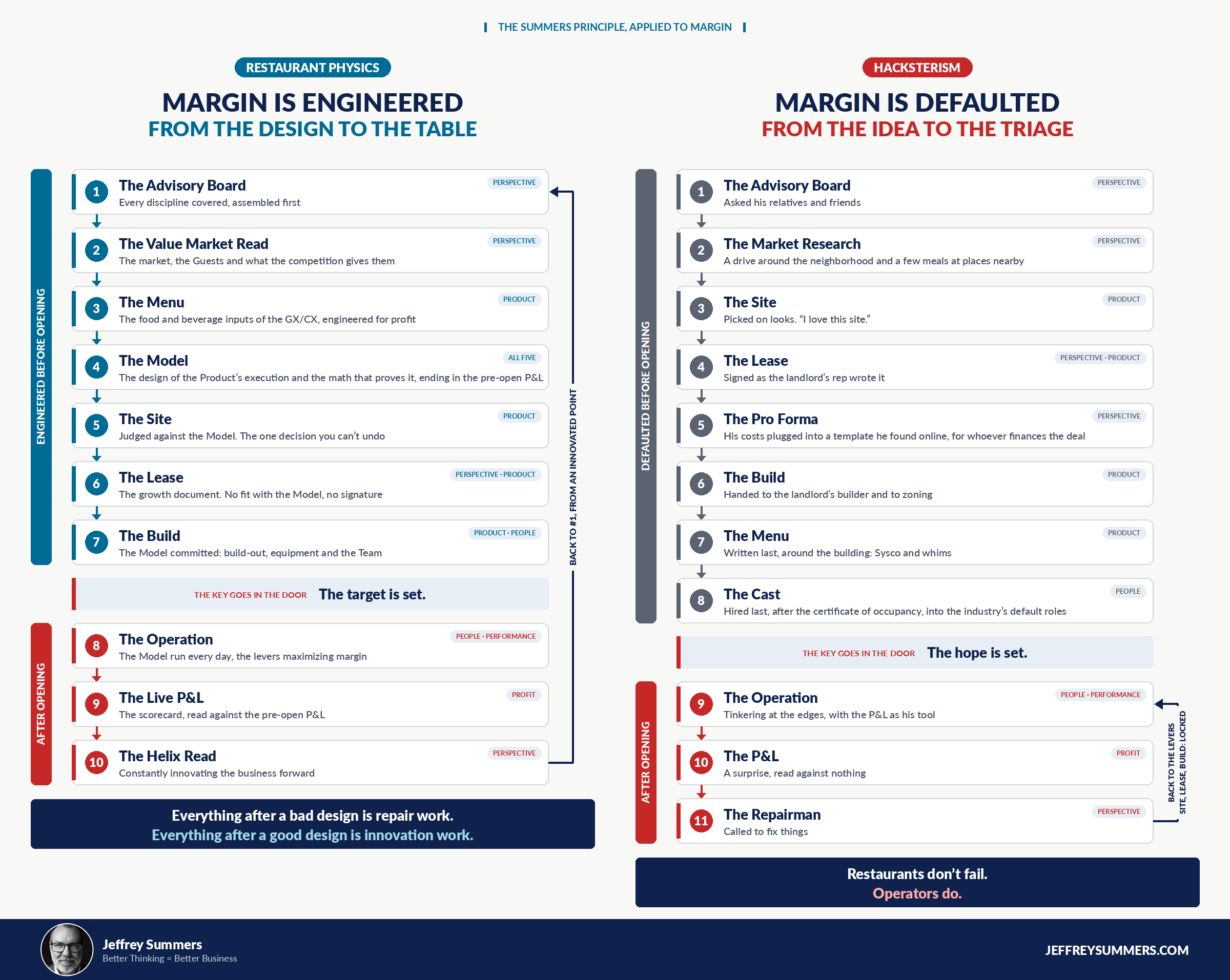
The default operator’s restaurant starts as an idea and a hope. His advisory board is his relatives and friends. His market research is a drive around the neighborhood and a few meals at places nearby. The site is picked on looks: “I love this site.” The lease is signed as the landlord’s rep wrote it. The pro forma is his costs plugged into a template he found online, built for whoever finances the deal. The build goes to the landlord’s builder and to zoning. The menu gets written last, around the building: Sysco and whims. The cast is hired last, after the certificate of occupancy, into the industry’s default roles.
Then the doors open and he tinkers at the edges, with the P&L as his tool. The P&L comes back a surprise, read against nothing, and the repairman gets called to fix things. By then the site, the lease and the build are locked. The edges can maximize margin potential. They can’t cut their way out of an occupancy cost nobody tested or a seat count that can’t produce the volume. Fifteen minutes before the lunch rush is the right habit for a designed restaurant. For a defaulted one, it’s triage.
The third of operators who weren’t profitable didn’t lose their margin in the first half of the year. They never had it. Restaurants don’t fail. Operators do.
How Margin Gets Engineered
The operator who engineers margin makes the same decisions in a different order, and judges each one against the ones before it.
He assembles an advisory board first, with every discipline the open will touch: the consultant, the GM, legal, accounting, finance, insurance, brand, technology, construction, equipment, a tenant-rep broker who works for him, an architect, an MEP engineer, an interior designer and a general contractor. He reads the market before he reads a site, so he knows who the Guests are, what they value and what the competition already gives them.
Then the menu, because the menu decides the building. It’s engineered for profit and priced with the X Factor, so the price carries the full burden of the business as modeled. Then the model: the design of the Product’s execution and the math that proves it, ending in a pre-open P&L built forward from real costs. Only then the site, judged against the model, and the lease, negotiated as the growth document. If the lease doesn’t fit the model, there’s no signature.
The build commits the model, and the Team comes first: the GM, the AGM, the Culinary Lead(s) and the front-of-house lead(s). The Team hires and trains the cast into roles the model already defined. When the key goes in the door, the target is set. The levers run every day to maximize the margin the design made room for. The live P&L is the scorecard, read line by line against the pre-open P&L, and every gap points back to the Fundamental that produced it. The Helix Read keeps innovating the business forward and sends it back to the first step from a higher point.
Everything after a bad design is repair work. Everything after a good design is innovation work.
Read the prosecution: https://hacksterism.jeffreysummers.com/margin-is-defaulted/
Read the architecture: https://physics.jeffreysummers.com/margin-is-engineered/
Read the method: https://jeffreysummers.com/how-i-plan-an-open/
One Move This Week
Pull the pro forma you opened on and last period’s P&L. Put them side by side, line by line. Every line where they don’t match is a decision, made or defaulted, and no daily report will close it. Find the biggest gap and trace it back to the decision that made it. If you haven’t signed yet, build the pre-open P&L forward from real costs first, and don’t sign until it clears.
— Jeffrey
Digging Deeper
Terms used in this piece: Lagging As Leading, X Factor, Summers Principle, Operating Helix, Repair Work, Innovation Work. Definitions in the Knowledge Base: https://kb.jeffreysummers.com/
SOURCES CITED IN THIS PIECE
MarginEdge, The Board: October 2026, 10.16.2026 — a third of operators told the National Restaurant Association they weren’t profitable in the first half of the year; “checking the score after the game is over”; “Spend 15 minutes on it before the lunch rush”; “Monthly is too slow for the number that decides whether you make money”; the holiday menu re-cost; the product demo invitation — https://www.marginedge.com/blog/the-board-october-2026