

The leak is the most comfortable diagnosis anyone can sell a restaurant operator, because it tells him the pipe is sound and the money is escaping through a hole, and in most restaurants the pipe is what’s broken.
Every ad and every other post in the feed is about operators leaking money. Find the 5 to 8 percent leaking from your kitchen. Plug the leaks in your food cost. The purest version I have heard is a guarantee: the seller will find enough in your leaks to pay his bill, and if he doesn’t, he works for free.
That is a bet he cannot lose. Every restaurant wastes something. Promising to find your fee in your leaks is promising to find dust in a kitchen. He also grades himself. Found money is whatever his spreadsheet says it is, and he is paid on found. Found is not kept. Nobody comes back in six periods to see whether the portion he tightened is still tight on a busy Saturday. And you pay him from your own margin, because the money he finds was already yours. If his fee is what the leak is worth, the leak was never the problem.
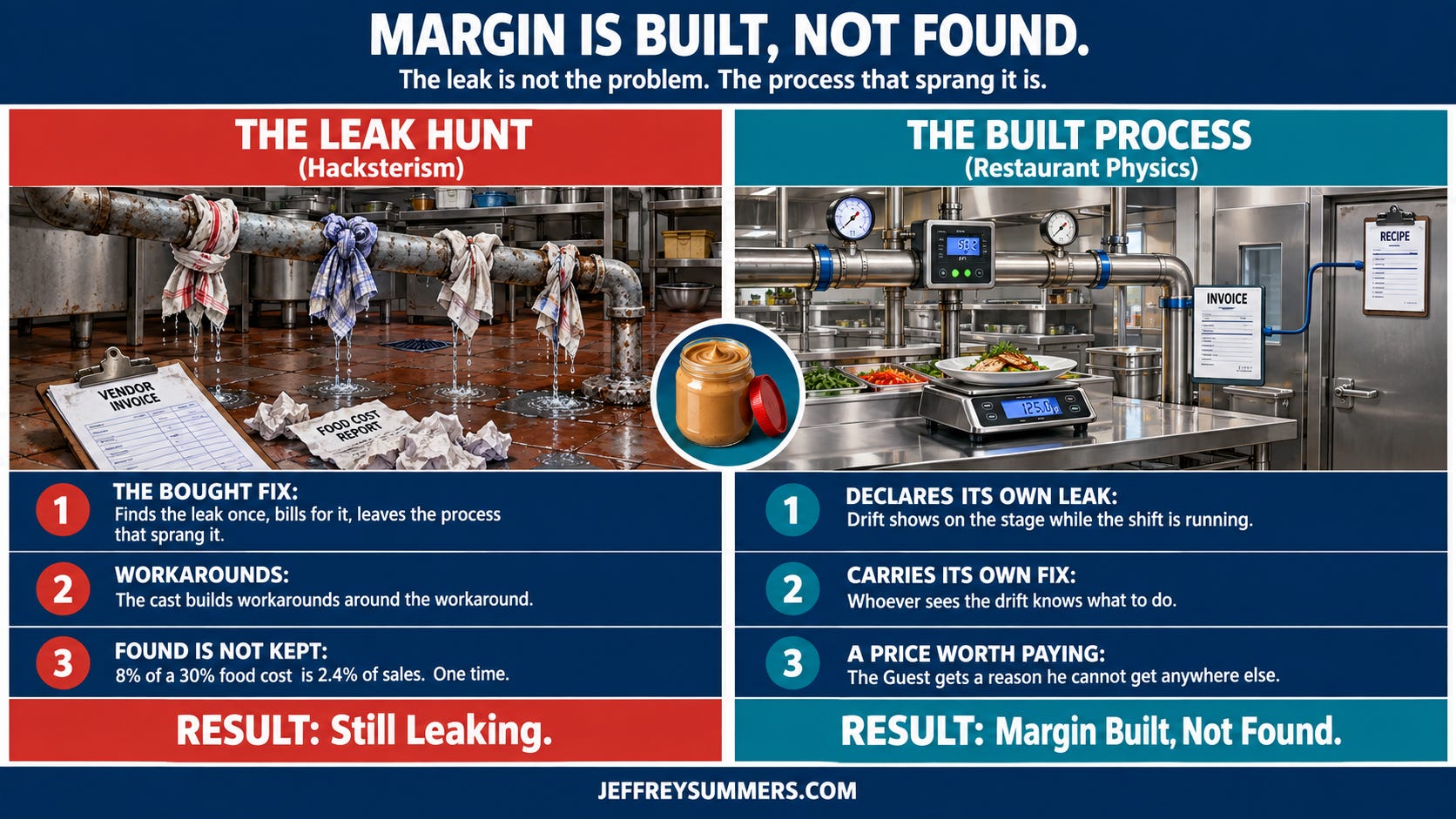
Run the arithmetic. Food runs 30 percent of sales. He finds the full 8 percent. That is 2.4 percent of sales. It moves a flat operation to a thin one and a losing operation to a slower loss. And you only find a leak once. Whatever produced the margin you have is still running next month. That is Repair Work, not a fix. It returns the operation to where it was, and where it was is what produced the problem.
Here is the joke in the title, stated plainly. You can find five money leaks in any restaurant the way you find peanut butter on the lid. They are always there. Take one $18 plate costed at $5.40, a 30 percent food cost on paper. Protein costed at purchase price yields about 75 percent, so the plate is really $6.60. The six-ounce portion goes out at eight on a busy Saturday and the plate is $8.20. The card built in January is wrong by July because the invoice moved and the card did not. The table that pushed back paid $14.40, 45.8 percent against the real plate. The platform took 30 percent before food cost, so the operator received $12.60 on a $6.60 plate. Then waste, over-ordering, shorted deliveries, invoice errors, recipe cards nobody updated, over-pouring at the bar, voids, theft, and the fuel surcharge now sitting on every case. That is fourteen, and I have not opened the walk-in.
Ask two questions of every one of them. Why didn’t the process declare it? Why did it spring? Every answer lands in the same place. The card never read yield. Nothing at the pass reads weight. Receiving checks the count and never the price. The cast member holding the check was never given the argument for the price. The menu was priced for the dining room and never for the platform. Bad process design, every time.
And every one of those leaks gets found the same way, after the fact, at period close. That is a second failure on top of the first: the process leaks, and the process cannot see its own leak. The leak seller is paid for the two things a good process already does.
Look at what he installs. A new count sheet. A portion scale. A comp code. A second approval on the invoice. Every one of them routes around the leak instead of taking it out. The fix is a workaround with a price tag on it. Then the cast builds their own workarounds around the bought one, because it does not fit how the shift runs. Workarounds on workarounds, the leak still at the bottom of the pile, and friction from production to service. My work calls where that ends Complexity Decline. When I am called into an operation that has spent years doing this, the first periods do not go to building anything. They go to undoing the fixes.
The newest version comes with a label printer. On September 28, MarginEdge launched SmartPrep, AI prep forecasting built from “sales history, purchases, recipes, inventory, shelf life and prep patterns.” All of it is what already happened. It gives one process real sight of its own drift, which is the right idea applied to the smallest leak in the building, and it preps the existing menu more precisely, including a menu priced from the wrong end.
The standard is simpler than any of it. If a process cannot declare a leak on its own and does not carry a fix for it, it is a bad process. A good one reads its own drift where it happens. Yield goes into the card, so the card is right the day it is written. Weight is read at the pass, so the cook knows the portion is heavy while he is plating it. The invoice is checked against the card at the back door. Every cast member holding a check can defend the price in thirty seconds. Every channel is priced for what it costs, or the plate comes off that channel. When a process stops fitting the operation, it gets redesigned, not patched.
Then build the margin itself, because stopping the leaks only stops you losing what you had. The margin comes from the gap between what you deliver and what the Guest can get anywhere else. The wider the gap, the more latitude on price. A leak is found once and ends where it started. The gap is built continuously, because a competitor is always closing it. So price from the other direction. What will this Guest pay for this plate in this restaurant? What does the plate have to cost to fit that price and still carry its share of the rent, the power, and the cast? If it cannot be made to fit, it is not a costing problem. It is a menu problem.
Read the prosecution: https://hacksterism.jeffreysummers.com/5-money-leaks-i-found-opening-a-jar-of-peanut-butter/
Read the architecture: https://physics.jeffreysummers.com/margin-is-built-not-found/
Read the rework: https://jeffreysummers.com/what-i-have-to-undo-before-i-can-fix-anything/
One move this week: pull the last four weeks of checks for your top five sellers. For each one, write down what the plate should have brought in at menu price, then what it actually brought in after comps, discounts, and delivery commission. Write down who comped what. Then take the biggest gap on the sheet and ask the two questions. Why didn’t the process declare it, and why did it spring?
— Jeffrey
Digging Deeper. Terms used in this piece: Repair Work, Complexity Decline, Friction. Definitions in the Knowledge Base,
https://kb.jeffreysummers.com/
The architecture taught in full: https://physics.jeffreysummers.com/
The arbitrage prosecuted in the wild: https://hacksterism.jeffreysummers.com/
The practice: https://jeffreysummers.com/
Sources cited:
GlobeNewswire, September 28, 2026 — MarginEdge SmartPrep launch; inputs listed as “sales history, purchases, recipes, inventory, shelf life and prep patterns”; label printer and dissolvable labels — https://www.globenewswire.com/news-release/2026/09/28/3369921/0/en/marginedge-launches-smartprep-bringing-ai-powered-forecasting-into-the-kitchen.html